
Technical notes
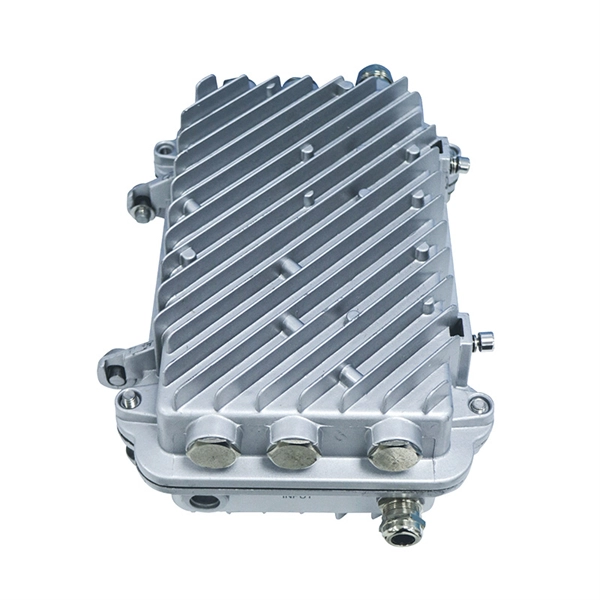
Distributed Feedback Laser
The simple design of fibre lasers with reflectors spread in space along light propagation direction is represented by the so-called distributed feedback (DFB) and distributed Bragg reflector (DBR) lasers.
Distributed Feedback Lasers – Buying Guide & Supplier
This distributed feedback lasers buying guide provides technical background, comparison of major types, selection criteria, and an overview of suppliers.
Distributed-feedback laser
A distributed-feedback laser (DFB) is a type of laser diode, quantum-cascade laser or optical-fiber laser where the active region of the device contains a periodically structured element or diffraction grating.
(PDF) Design and fabrication of a four-channel CWDM
This article presents the design, fabrication, and testing methodology of a four-channel coarse wavelength division multiplexing (CWDM) cooled
Distributed-Feedback Lasers (DFB)
Distributed-Feedback Lasers (DFB) A distributed feedback laser is type of semiconductor laser utilizes the Bragg reflection of a diffraction grating along an active waveguide to consolidate the laser''s
Distributed Feedback Lasers Features & Technology | nanoplus
nanoplus Distributed Feedback Lasers allow for high performance gas sensing applying tunable diode laser spectroscopy. Learn more about their features and technology.
DFB Laser | distributed feedback (DFB) lasers diodes
Our Distributed Feedback (DFB) Lasers provide single-frequency output with unparalleled wavelength stability, ideal for gas sensing/molecular spectroscopy,
Distributed Feedback Lasers
This is almost universally realized by putting a wavelength-dependent reflector into the laser cavity, in a distributed feedback laser. In this chapter, the physics, properties, fabrication, and yields of
Advanced distributed feedback lasers based on composite fiber
In this paper, we fabricate DFB laser in a composite fiber with high Er 3+ concentration (3 wt%). The composite fiber was fabricated by melting rare-earth doped phosphate glass in silica tube...
DFB Lasers | Technical Guide | SELECTION GUIDE
The acronym DFB laser stands for distributed feedback laser. Their key features relative to other semiconductor lasers are their single longitudinal
Distributed Feedback Lasers – DFB laser
Distributed feedback lasers are diode or fiber lasers where the whole laser resonator consists of a periodic structure, in which Bragg reflection occurs.
Chapter 9.6.2: Distributed Feedback Lasers | GlobalSpec
9.6.2 Distributed Feedback Lasers Applications such as high-speed data transmission in fiber optics require limiting laser emission to a narrower range of wavelengths than possible with a Fabry Perot
Distributed Feedback Laser | Precision, Stability
Distributed Feedback Lasers: Unveiling a World of Precision, Stability, and Coherence Distributed Feedback Lasers (DFB) are a pivotal
Design and realization of high-power DFB lasers
Single-frequency, single-spatial mode distributed feedback (DFB) and distributed Bragg reflector (DBR) lasers have important applications in communication, spectroscopy, frequency conversion, atomic
Distributed-Feedback Lasers | Springer Nature Link
Most of the lasers that have been described so are depend on optical feedback from a pair of reflecting surfaces, which form a Fabry-Perot etalon. In an optical integrated circuit, in which the
DFB (Distributed Feedback) Semiconductor Lasers
This is a continuation from the previous tutorial - effects of external optical feedback on semiconductor lasers. Introduction to distributed-feedback semiconductor
Distributed Feedback (DFB) Lasers
You have just eaten a Fabry-Perot donut. The aim of a distributed feedback (DFB) laser is to sharpen up the output of regular Fabry-Perot lasers.
Distributed Feedback Lasers
Good-quality long-distance optical transmission over fiber needs lasers which emit at a single wavelength. This is almost universally realized by putting a wavelength-dependent reflector into the
Related Video Reference
This video was associated with the source search result. Verify technical details against current product documentation and project requirements.